
Maximum Loss and Mean-Absolute Deviation risk measures
Want to share your content on R-bloggers? click here if you have a blog, or here if you don't.
During construction of typical efficient frontier, risk is usually measured by the standard deviation of the portfolio’s return. Maximum Loss and Mean-Absolute Deviation are alternative measures of risk that I will use to construct efficient frontier. I will use methods presented in Comparative Analysis of Linear Portfolio Rebalancing Strategies: An Application to Hedge Funds by Krokhmal, P., S. Uryasev, and G. Zrazhevsky (2001) paper to construct optimal portfolios.
Let x.i, i= 1,…,n be weights of instruments in the portfolio. We suppose that j= 1,…,T scenarios of returns with equal probabilities are available. I will use historical assets returns as scenarios. Let us denote by r.ij the return of i-th asset in the scenario j. The portfolio’s Maximum Loss (page 34) can be written as

It can be formulated as a linear programming problem
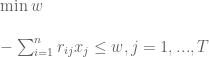
This linear programming problem can be easily implemented
min.maxloss.portfolio <- function
(
	ia,				# input assumptions
	constraints		# constraints
)
{
	n = ia$n
	nt = nrow(ia$hist.returns)

	# objective : maximum loss, w
	f.obj = c( rep(0, n), 1)

	# adjust prior constraints, add w
	f.con = rbind(constraints$A, 0)
	f.dir = c(rep('=', constraints$meq), rep('>=', len(constraints$b) - constraints$meq))
	f.rhs = constraints$b

	# -SUM <over i> r.ij * x.i <= w, for each j from 1 ... T
	a1 = rbind( matrix(0, n, nt), 0)
	b1 = rep(0, nt)
		a1[1:n,] = t(ia$hist.returns)
		a1[(n + 1),] = +1		# w

	f.con = cbind( f.con, a1 )
	f.dir = c(f.dir, rep('>=', nt))
	f.rhs = c(f.rhs, b1)

	# find optimal solution
	x = NA
	sol = try(lp.anyx('min', f.obj, t(f.con), f.dir, f.rhs, -100), TRUE)

	if(!inherits(sol, 'try-error')) {
		x = sol$solution[1:n]

	}

	return( x )
}
The portfolio’s Mean-Absolute Deviation (MAD) (page 33) can be written as

It can be formulated as a linear programming problem
%5Cnewline%5Cnewline+%5Csum_%7Bi=1%7D%5E%7Bn%7Dr_%7Bij%7Dx_%7Bi%7D+-+%5Cfrac%7B1%7D%7BT%7D%5Csum_%7Bj=1%7D%5E%7BT%7D%5Csum_%7Bi=1%7D%5E%7Bn%7Dr_%7Bij%7Dx_%7Bi%7D=u_%7Bj%7D%5E%7B+%7D-u_%7Bj%7D%5E%7B-%7D,+j=1,...,T%5Cnewline%5Cnewline+u_%7Bj%7D%5E%7B+%7D,u_%7Bj%7D%5E%7B-%7D+%5Cgeq+0,+j=1,...,T&bg=ffffff&fg=555555&s=0 "\min_{}{}\frac{1}{T}\sum_{j=1}^{T}(u_{j}^{+}+u_{j}^{-})\newline\newline \sum_{i=1}^{n}r_{ij}x_{i} - \frac{1}{T}\sum_{j=1}^{T}\sum_{i=1}^{n}r_{ij}x_{i}=u_{j}^{+}-u_{j}^{-}, j=1,...,T\newline\newline u_{j}^{+},u_{j}^{-} \geq 0, j=1,...,T")
This linear programming problem can be implemented
min.mad.portfolio (
	ia,			# input assumptions
	constraints		# constraints
)
{
	n = ia$n
	nt = nrow(ia$hist.returns)

	# objective : Mean-Absolute Deviation (MAD)
	# 1/T * [ SUM  (u+.j + u-.j) ]
	f.obj = c( rep(0, n), (1/nt) * rep(1, 2 * nt) )

	# adjust prior constraints, add u+.j, u-.j
	f.con = rbind( constraints$A, matrix(0, 2 * nt, ncol(constraints$A) ) )
	f.dir = c(rep('=', constraints$meq), rep('>=', len(constraints$b) - constraints$meq))
	f.rhs = constraints$b

	# [ SUM  r.ij * x.i ] - 1/T * [ SUM  [ SUM  r.ij * x.i ] ] = u+.j - u-.j , for each j = 1,...,T
	a1 = rbind( matrix(0, n, nt), -diag(nt), diag(nt))
	b1 = rep(0, nt)
		a1[1:n,] = t(ia$hist.returns) - repmat(colMeans(ia$hist.returns), 1, nt)

	f.con = cbind( f.con, a1 )
	f.dir = c(f.dir, rep('=', nt))
	f.rhs = c(f.rhs, b1)

	# find optimal solution
	x = NA
	min.x.bounds = c( rep(-100, n), rep(0, 2 * nt) )
	sol = try(lp.anyx('min', f.obj, t(f.con), f.dir, f.rhs, min.x.bounds), TRUE)

	if(!inherits(sol, 'try-error')) {
		x = sol$solution[1:n]
	}

	return( x )
}
Let’s examine efficient frontiers computed under different risk measures using historical input assumptions presented in the Introduction to Asset Allocation post:
###############################################################################
# Create Efficient Frontier
###############################################################################
	n = ia$n

	# x.i >= 0
	constraints = new.constraints(diag(n), rep(0, n), type = '>=')

	# x.i 	constraints = add.constraints(diag(n), rep(0.8, n), type = '
	# SUM x.i = 1
	constraints = add.constraints(rep(1, n), 1, type = '=', constraints)

	# create efficient frontier(s)
	ef.risk = portopt(ia, constraints, 50, 'Risk')
	ef.maxloss = portopt(ia, constraints, 50, 'Max Loss', min.maxloss.portfolio)
	ef.mad = portopt(ia, constraints, 50, 'MAD', min.mad.portfolio)

	# Plot multiple Efficient Frontiers
	layout( matrix(1:4, nrow = 2) )
	plot.ef(ia, list(ef.risk, ef.maxloss, ef.mad), portfolio.risk, F)
	plot.ef(ia, list(ef.risk, ef.maxloss, ef.mad), portfolio.maxloss, F)
	plot.ef(ia, list(ef.risk, ef.maxloss, ef.mad), portfolio.mad, F)

	# Plot multiple Transition Maps
	layout( matrix(1:4, nrow = 2) )
	plot.transitopn.map(ef.risk)
	plot.transitopn.map(ef.maxloss)
	plot.transitopn.map(ef.mad)


The Mean-Absolute Deviation and Standard Deviation risk measures are very similar by construction – they both measure average deviation, so it is not a surprise that their efficient frontiers and transition maps are close. On the other hand, the Maximum Loss measures the extreme deviation and has very different efficient frontier and transition map.


R-bloggers.com offers daily e-mail updates about R news and tutorials about learning R and many other topics. Click here if you're looking to post or find an R/data-science job.
Want to share your content on R-bloggers? click here if you have a blog, or here if you don't.