
Complex arithmetic and airplane wings
Want to share your content on R-bloggers? click here if you have a blog, or here if you don't.
I was once told that the reason that such a shape was so commonly used for aeroplane wings was merely that then one could study it mathemtically by just employing the Zhoukowski transformation. I hope that this is not true!
(R. Penrose, “The Road to Reality”, p.150)
Penrose here talks about a complex holomorphic mapping also known as the aerofoil transformation.
What you need is a cirlce in the complex plane, described by the complex function 


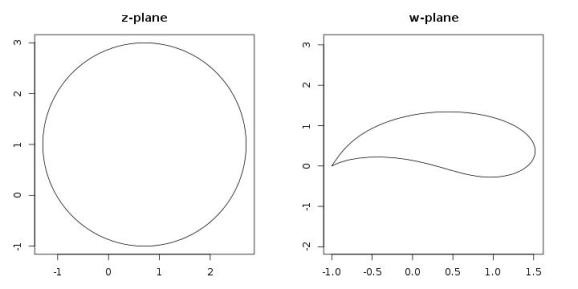
transforms this circle into the cross section of an airplane wing.
Let’s look at this in R. Fortunately, R has some complex number arithmetic already built in. A suitable circle is constructed by
z <- complex(mod=2,argument=seq(0,2*pi,len=100))+(sqrt(0.5)+1i)
and the plot below (Fig. 8.15 in “Road to Reality”) is produced by
par(mfrow=c(1,2),mar=rep(3,4))
plot(z,type="l",asp=1,main="z-plane")
plot((z+1/z)/2,type="l",main="w-plane",asp=0.5)
Maybe at some point I also understand what Penrose means by
… the (idealized) airflow around [the wing] can be directly obtained from that around a ‘wing’ of circular cross-section
Is it true that a vector field on the surface of the circle directly transforms into the wind field around the wing? How do you transform a vector field by the above equation? Does the transformed wind field explain why the plane flies? Would be nice indeed, but this is another post.

R-bloggers.com offers daily e-mail updates about R news and tutorials about learning R and many other topics. Click here if you're looking to post or find an R/data-science job.
Want to share your content on R-bloggers? click here if you have a blog, or here if you don't.