
New Le Monde puzzle
Want to share your content on R-bloggers? click here if you have a blog, or here if you don't.
When I first read Le Monde puzzle this weekend, I though it was even less exciting than the previous one: find

such that


The solution is obtained by brute-force checking through an R program:

and then the a next solution is 
However, while waiting in the plane to Edinburgh, I thought more about it and found that the problem can be solved with paper and pencil. It goes like this. There exists an integer


Hence, solving the second degree equation,

which implies that

is one of the integral factors of

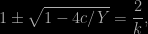
we get

and thus

We thus deduce that 


The conclusion is thus that any 





we see (without any R programming) that 


An approach avoiding the second degree equation is to notice that 

which implies

thus that 


Filed under: Kids, R Tagged: Le Monde, puzzle


R-bloggers.com offers daily e-mail updates about R news and tutorials about learning R and many other topics. Click here if you're looking to post or find an R/data-science job.
Want to share your content on R-bloggers? click here if you have a blog, or here if you don't.