
Visualising Tourism Data using R with googleVis package
[This article was first published on Pairach Piboonrungroj » R, and kindly contributed to R-bloggers]. (You can report issue about the content on this page here)
Want to share your content on R-bloggers? click here if you have a blog, or here if you don't.
Want to share your content on R-bloggers? click here if you have a blog, or here if you don't.
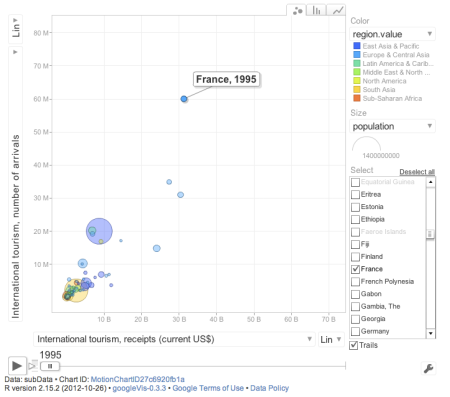
Inspired by Mages’s post on Accessing and plotting World bank data with R (using googleVis package), I created one visualising tourism receipts and international tourist arrivals of various countries since 1995. The data used are from the World Bank’s country indicators.
To see the motion chart, double click a picture below.

Code
install.packages("googleVis")
library('googleVis')

getWorldBankData <- function(id='SP.POP.TOTL', date='1960:2010',
 value="value", per.page=12000){
 require(RJSONIO)
 url <- paste("http://api.worldbank.org/countries/all/indicators/", id,
 "?date=", date, "&format=json&per_page=", per.page,
 sep="")

 wbData <- fromJSON(url)[[2]]

 wbData = data.frame(
 year = as.numeric(sapply(wbData, "[[", "date")),
 value = as.numeric(sapply(wbData, function(x)
 ifelse(is.null(x[["value"]]),NA, x[["value"]]))),
 country.name = sapply(wbData, function(x) x[["country"]]['value']),
 country.id = sapply(wbData, function(x) x[["country"]]['id'])
 )

 names(wbData)[2] <- value

 return(wbData)
}

getWorldBankCountries <- function(){
 require(RJSONIO)
 wbCountries <-
 fromJSON("http://api.worldbank.org/countries?per_page=12000&format=json")
 wbCountries <- data.frame(t(sapply(wbCountries[[2]], unlist)))
 wbCountries$longitude <- as.numeric(wbCountries$longitude)
 wbCountries$latitude <- as.numeric(wbCountries$latitude)
 levels(wbCountries$region.value) <- gsub(" \\(all income levels\\)",
 "", levels(wbCountries$region.value))
 return(wbCountries)
}

## Create a string 1960:this year, e.g. 1960:2011
years <- paste("1960:", format(Sys.Date(), "%Y"), sep="")

## International Tourism Arrivals
inter.tourist.arrivals<- getWorldBankData(id='ST.INT.ARVL',
 date=years, value="International tourism, number of arrivals")

## International Tourism Receipts
tourism.receipts <- getWorldBankData(id='ST.INT.RCPT.CD', date=years,
 value="International tourism, receipts (current US$)")

## Population
population <- getWorldBankData(id='SP.POP.TOTL', date=years,
 value="population")

## GDP per capita (current US$)
GDP.per.capita <- getWorldBankData(id='NY.GDP.PCAP.CD',
 date=years,
 value="GDP.per.capita.Current.USD")

## Merge data sets
wbData <- merge(tourism.receipts, inter.tourist.arrivals)
wbData <- merge(wbData, population)
wbData <- merge(wbData, GDP.per.capita)

## Get country mappings
wbCountries <- getWorldBankCountries()

## Add regional information
wbData <- merge(wbData, wbCountries[c 1=""region.value"," 2=""incomeLevel.value")" language="("iso2Code","][/c],
 by.x="country.id", by.y="iso2Code")

## Filter out the aggregates and country id column
subData <- subset(wbData, !region.value %in% "Aggregates" , select=
 -country.id)

## Create a motion chart
M <- gvisMotionChart(subData, idvar="country.name", timevar="year",
 options=list(width=700, height=600))

## Display the chart in your browser
plot(M)

# save as a file
print(M, file="myGoogleVisChart.html")
Filed under: R, Tourism


To leave a comment for the author, please follow the link and comment on their blog: Pairach Piboonrungroj » R.
R-bloggers.com offers daily e-mail updates about R news and tutorials about learning R and many other topics. Click here if you're looking to post or find an R/data-science job.
Want to share your content on R-bloggers? click here if you have a blog, or here if you don't.